
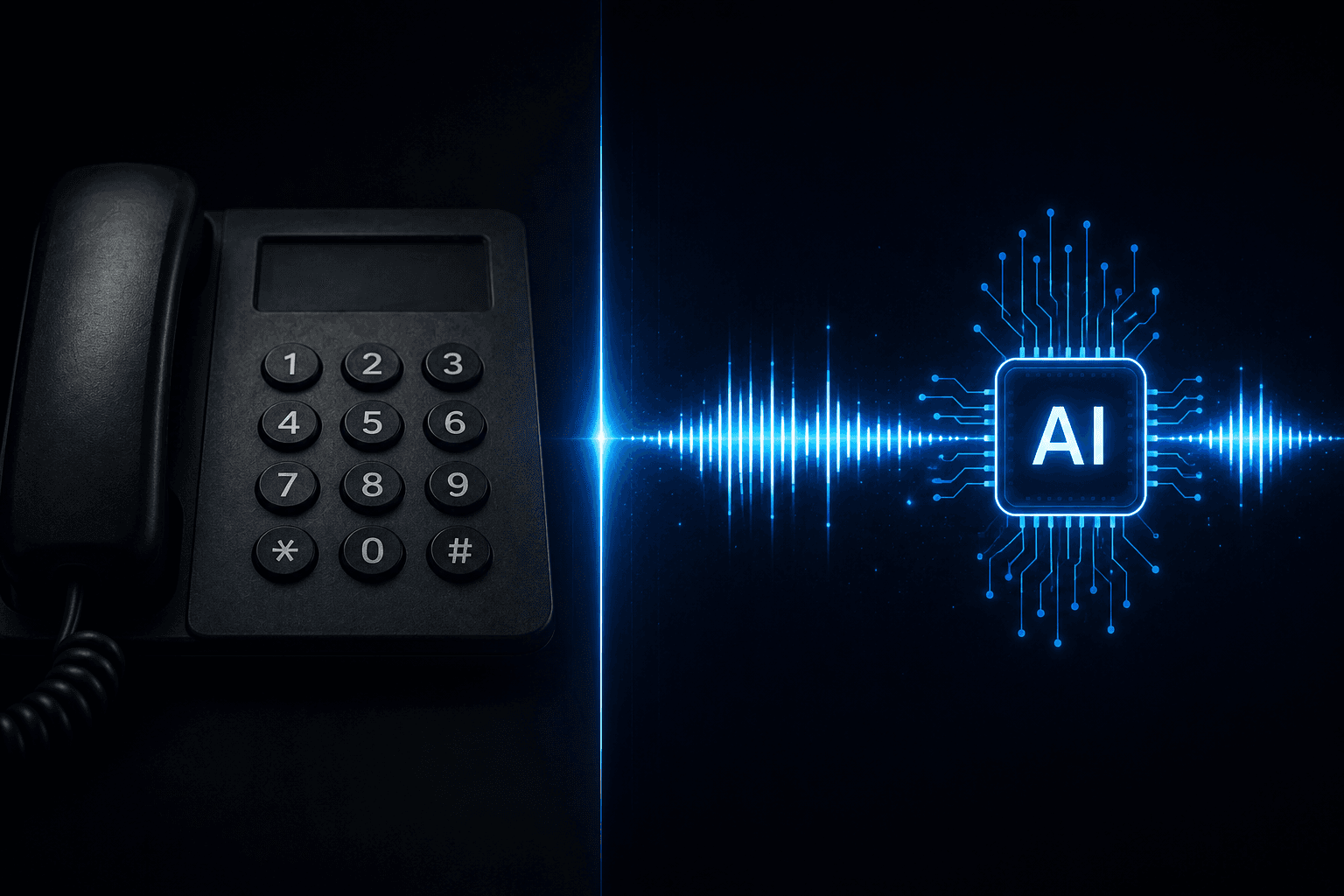
An IVR (interactive voice response) routes calls via pre-built menu trees — “press 1 for billing, press 2 for support.” An AI voice agent understands natural language, holds a conversation, and resolves the caller’s issue without menus or keypresses. For most businesses in 2026, AI voice agents deliver 55–75% call containment vs 20–35% for traditional IVR — while improving caller satisfaction scores.
How IVR works
Traditional IVR presents callers with options, records DTMF (keypad) input or basic speech recognition, and routes calls to the right queue. The caller says “1” or “billing” and gets transferred.
IVR strengths:
- Very cheap to run — no LLM inference costs
- Extremely reliable — deterministic routing
- Works well for simple, high-volume routing (“speak your account number”)
IVR weaknesses:
- Callers hate it — 67% of callers prefer to speak to a human over navigating IVR menus (Nuance research)
- High abandonment — callers hang up before finding the right option
- Zero conversation ability — can’t handle anything not in the menu
- Can’t resolve issues — can only route, not help
How AI voice agents work
An AI voice agent listens to the caller’s natural speech, understands intent (“I need to reschedule my appointment on Thursday”), and takes action — querying your calendar, making the change, and confirming — in a natural conversation.
AI voice agent strengths:
- Natural language — callers speak normally, no menus
- High containment — resolves 55–75% of calls without human transfer
- Actions — can book appointments, update records, process payments
- Available 24/7 — handles after-hours calls that IVR drops to voicemail
AI voice agent weaknesses:
- Higher cost per minute ($0.15–0.33 vs near-zero for IVR)
- Requires more setup and ongoing tuning
- Can fail on very unusual inputs if the system prompt doesn’t cover them
Head-to-head comparison
| Dimension | IVR | AI Voice Agent |
|---|---|---|
| — | — | — |
| Call containment | 20–35% | 55–75% |
| Caller satisfaction | Low (industry-wide complaint) | High (natural conversation) |
| Cost per minute | Near-zero (hosting only) | $0.15–0.33 |
| Setup time | Days | Days–weeks |
| Actions during call | Route only | Book, update, query, process |
| After-hours handling | Voicemail drop | Full resolution |
| Complex queries | Cannot handle | Resolves or escalates intelligently |
| Natural language | Basic keyword matching | Full NLU |
When IVR still makes sense
IVR is not dead. It still makes sense when:
- Pure routing is sufficient. If callers need to reach one of three departments and nothing else, IVR does this for almost zero cost.
- Volume is so high that LLM costs matter. At 1 million calls/month, even a $0.05/call AI cost adds $50,000/month. IVR routing is essentially free.
- Calls are extremely short and structured. Account balance inquiries, shipping status with a tracking number — these work fine with basic speech recognition.
When AI voice agents win
AI agents beat IVR when:
- Callers need to do something, not just be routed (book, cancel, update, pay)
- Your call volume is moderate and containment rate drives ROI (fewer human agents needed)
- After-hours calls are currently going to voicemail and being lost
- Your IVR has more than 3 menu levels (complexity kills IVR containment)
- Caller satisfaction is a differentiator in your market
The hybrid approach
Many enterprise deployments use both: IVR for the initial routing (to handle regulatory disclosures or simple routing at zero cost), then hand off to an AI agent for resolution. This minimises LLM cost for the routing layer while getting the conversational benefits where they matter.
Migration from IVR to AI voice agent
Step 1: Audit your current IVR — what percentage of calls reach each menu option? What percentage abandon?
Step 2: Identify your highest-volume, most frequently abandoned path. That’s where AI delivers the fastest ROI.
Step 3: Build an AI agent for that specific path and run it in parallel with the IVR for 30 days.
Step 4: Compare containment rates, satisfaction, and cost. The data will tell you whether to expand the AI.
Hestur AI specialises in IVR replacement and modernisation — mapping your existing call flows to AI-native architectures. Book a discovery call.