
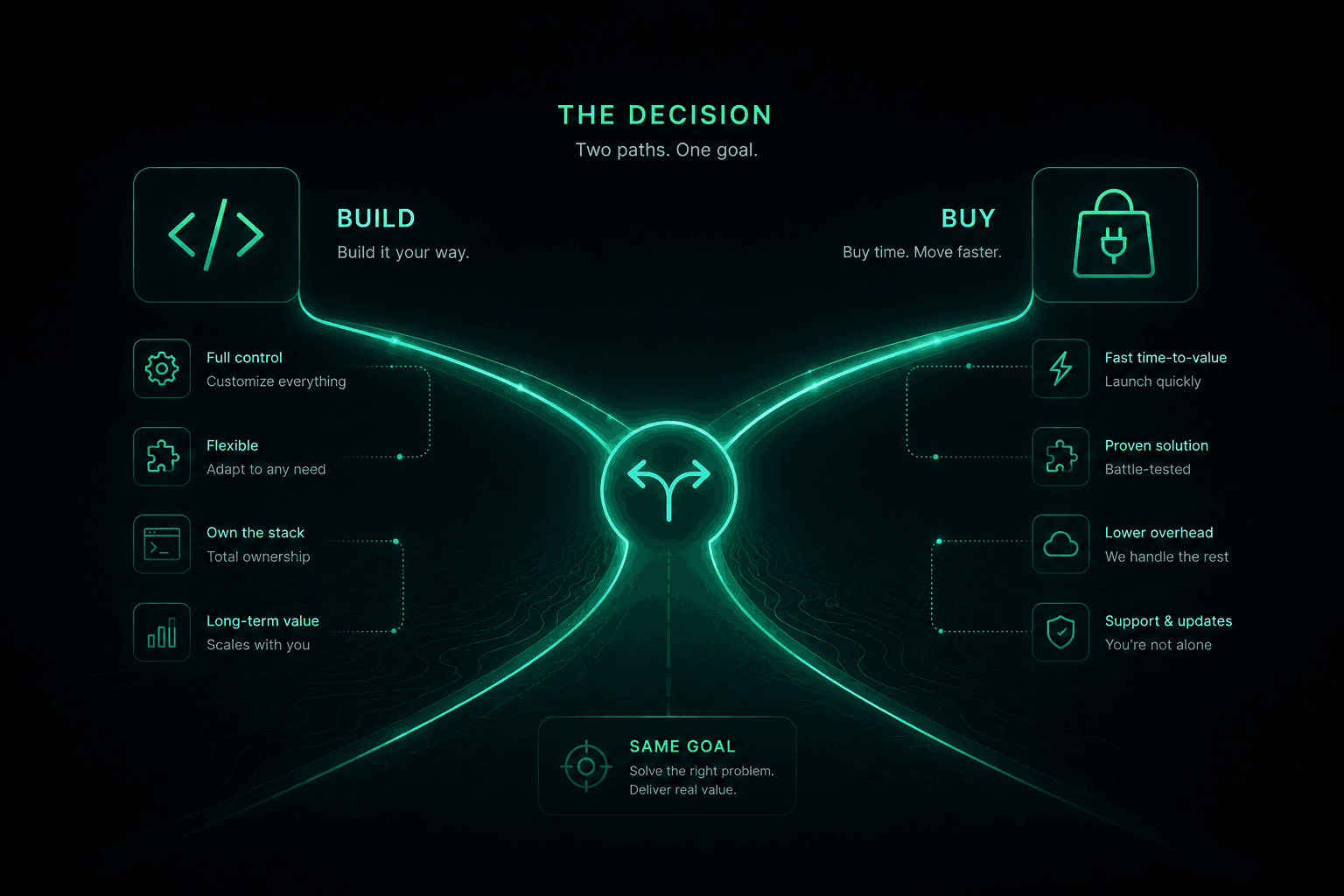
The build-vs-buy decision for AI is different from traditional software procurement. AI products are changing faster than most enterprise procurement cycles, the switching costs are often lower than expected, and the “buy” options in 2026 are dramatically more capable than they were two years ago. Here’s a framework for making the decision clearly.
Why the traditional build-vs-buy framework doesn’t fully apply
Traditional build-vs-buy analysis asks: is this a competitive differentiator, or is it a commodity? If commodity, buy. If differentiator, build.
AI complicates this because:
- Many AI products are commoditising fast. A feature that required a custom build in 2023 (sentiment analysis, document summarisation, basic chat) can now be bought off the shelf. The build premium has fallen dramatically.
- Off-the-shelf AI products often contain your competitors’ data patterns. Vertical AI tools trained on industry data may improve a competitor’s performance as much as yours.
- Custom AI can encode proprietary data. If you have unique data (customer interactions, domain expertise, historical outcomes) that competitors don’t have, custom AI built on that data may be genuinely defensible.
- Switching costs are lower than for traditional enterprise software. AI systems often have less lock-in than CRMs or ERPs. A well-designed custom RAG system can switch underlying LLM providers without rebuilding everything.
The four questions that actually determine build vs buy
1. Is this capability unique to your business?
If the AI capability you need is generic — customer support chat, document summarisation, meeting notes, email drafting — buy. These are solved problems and off-the-shelf tools do them well.
If the capability requires deep knowledge of your specific domain, workflows, data, or customers — build. A revenue leakage detection system trained on your specific billing patterns is not replaceable by a generic analytics tool.
2. Do you have proprietary data that would make custom AI better?
Off-the-shelf AI is trained on general data. If your competitive advantage lies in specific historical data (decades of customer interactions, proprietary pricing models, unique outcome records), building AI on top of that data may produce better results than any general product.
If you don’t have meaningfully differentiated data, you’re buying compute and inference — in which case off-the-shelf is almost always cheaper and faster.
3. How quickly does this domain move?
For fast-moving areas (LLM capabilities, AI reasoning, image/video generation), buy or use APIs — the underlying models improve rapidly and you want to benefit from those improvements without rebuilding. Building your own LLM is almost never justified for a business application.
For slower-moving domain-specific layers (your specific workflow logic, your customer data, your integration requirements), build. These don’t change with each model release.
4. What is the cost of imperfect AI here?
In low-stakes applications (internal productivity, content drafting, meeting summaries), off-the-shelf AI that’s right 85% of the time is fine. In high-stakes applications (medical diagnosis assistance, financial recommendations, compliance classification), even 1% error rates may be unacceptable and require custom validation layers that a generic product can’t provide.
Common mistake 1: Building what you should buy
Teams build custom AI for document summarisation, meeting notes, customer support chat, and email drafting — all of which have excellent off-the-shelf solutions. The build cost is $30K–80K, the maintenance cost is ongoing, and the result is rarely better than NotionAI, Notion Calendar, Intercom, or HubSpot’s AI features.
The test: search for what you’re about to build. If multiple well-funded products already do it, buy.
Common mistake 2: Buying when you need custom integration
Many “buy” decisions still require significant integration work. A customer support AI that connects to your proprietary ticketing system, reads your internal knowledge base, and escalates through your specific workflow is not a 30-minute SaaS setup — it’s a 6–12 week project regardless of which base platform you use.
The hidden cost of “buy” is integration. Budget realistically for it.
Common mistake 3: Over-building because the future is uncertain
Teams build flexible, scalable, multi-tenant AI platforms because “we might need it someday.” They spend 6 months and $200K building infrastructure for use cases that never materialise.
Build for what you need now with reasonable extensibility. Three months of production experience will tell you more about what you actually need than any upfront planning session.
A practical scoring model
Score each of the following 1–5, then add up:
| Factor | Score toward BUILD | Score toward BUY |
|---|