
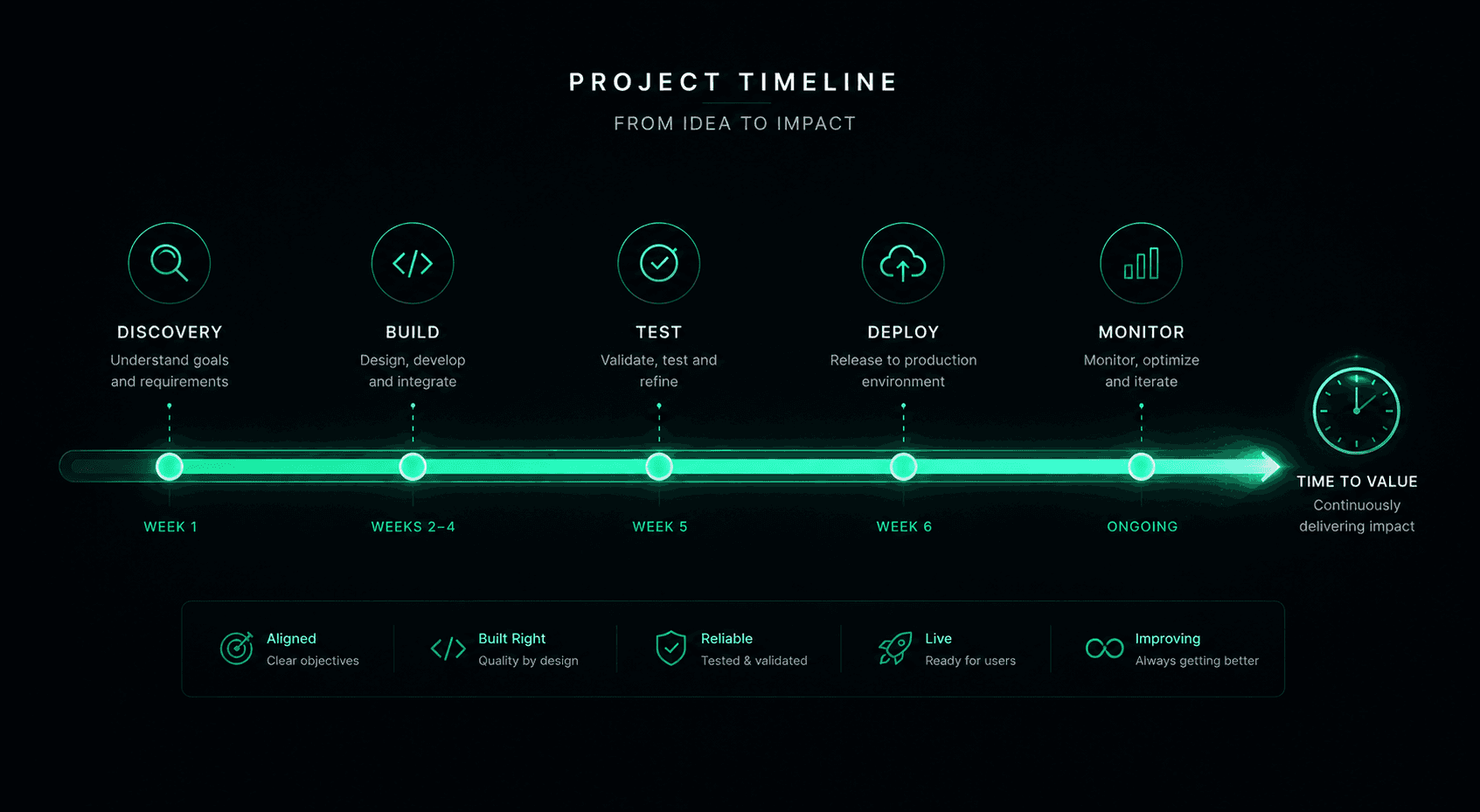
Most teams underestimate how long it takes to move from a demo agent to a production-ready system. A prototype can be built in 1–5 days, but a robust, reliable agent typically takes 3–12 weeks depending on complexity.
The model itself is rarely the bottleneck. Modern LLMs are quick to integrate; the real work is everything around the model: wiring it into your systems, handling failures, managing state, and making sure it behaves safely under real-world conditions.
Prototype: 1–5 days
A fast prototype is easy with tools like Vapi, LangChain, or the OpenAI Assistants API. In a couple of days you can build an agent that:
- Uses one or two tools (usually simple API calls)
- Works on a narrow happy path
- Has minimal error handling (basic try/catch)
- Has no logging, monitoring, or retries
- Is only tested manually by the developer
This kind of agent looks impressive in a demo but breaks quickly with unexpected inputs, slow or flaky APIs, or unanticipated user behavior.
Single-tool production agent: 3–6 weeks
Turning a demo into a reliable production agent is where the real engineering effort lies. For a focused, single-use-case agent (e.g. a dental appointment booking agent), a realistic timeline is:
Week 1 – Integration and data work
- Connect to real systems (CRM, calendar, database)
- Deal with auth, pagination, rate limits, and API quirks
Week 2 – Conversation design and prompts
- Design flows for the full range of user inputs
- Handle misunderstandings and edge cases gracefully
- Decide when to clarify vs. infer
Weeks 3–4 – Hardening
- Robust error handling and retries
- Logging of all inputs/outputs
- Monitoring and basic dashboards
- Human escalation paths
- Load and edge-case testing
Weeks 5–6 – Testing and go-live
- Staging with real users or real traffic
- Fixing discovered issues
- Phased rollout into production
Multi-tool production agent: 6–12 weeks
Each additional integration multiplies complexity. An agent that can query a CRM, check calendars, send emails, update databases, and escalate to humans now depends on multiple systems that can each fail or misbehave.
Extra time is spent on:
- Integration testing across combinations of tools
- State management for multi-step tasks
- Error recovery when some tool calls succeed and others fail
- Access control and permissions
- Cost control for potentially many LLM calls per request
Multi-agent systems: 8–16+ weeks
When you orchestrate multiple specialized agents (research, execution, QA, etc.), you’re effectively building a distributed system powered by LLMs. Timelines extend because you must design:
- Inter-agent communication
- Shared state and context
- Conflict resolution
- Orchestration and coordination logic
This architecture is often right for complex workflows, but it must be treated as a substantial engineering project, not a small extension of a single agent.
What really drives the timeline
Most underestimates come from ignoring integration and organizational complexity. The biggest drivers are:
1. Number of systems to connect
Each integration typically adds 2–5 days. Real-world APIs require OAuth, webhooks, field mapping, and rate-limit handling.
2. Data quality
Messy, inconsistent, or incomplete data requires a data-cleaning or normalization phase. Agent reliability is bounded by data quality.
3. Stakeholder review cycles
If the agent affects real business operations (scheduling, pricing, customer comms), expect review from ops, legal, and compliance, especially in regulated industries.
Build in-house vs. hire
- If you already have engineers with production agent experience, building in-house is usually best.
- If this is your first production agent, the learning-curve cost (and risk of failures in production) often exceeds the cost of working with a team that has done it before.
At Hestur, focused production agents typically take 2–4 weeks because the integration and hardening patterns are already established. If you have a tight deadline or complex systems, a free scoping call can quickly clarify whether your timeline is realistic and where the main risks lie.