
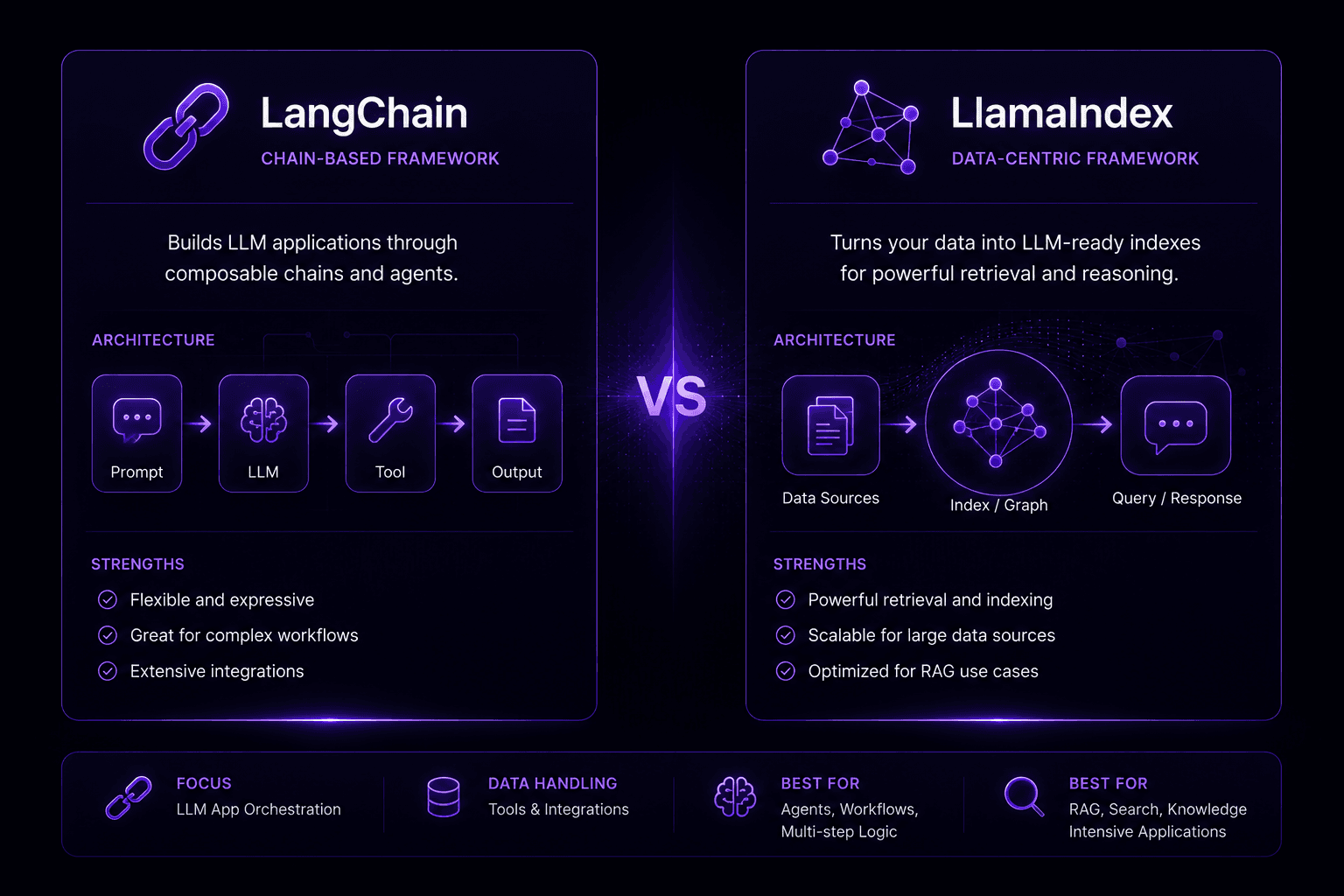
Use LlamaIndex if your core challenge is retrieval: ingesting documents, chunking them well, indexing across many sources, and getting the right content back. Use LangChain (specifically LangGraph) if you're building complex multi-step agents with branching logic, tool use, and state management. For most RAG applications, start with LlamaIndex. For most agent orchestration projects, start with LangGraph. You can use both together.
What are LangChain and LlamaIndex?
LangChain is a framework for building applications with LLMs. It started as a way to chain together LLM calls and tool use, and has grown into a broad platform covering agents, RAG, evaluation, and production deployment (LangSmith, LangGraph, LangServe).
LlamaIndex (formerly GPT Index) is a data framework for LLM applications. It focuses specifically on connecting LLMs to external data sources: documents, databases, APIs. It's the go-to choice when retrieval accuracy is the core engineering challenge.
The core difference: LangChain is a general-purpose LLM application framework. LlamaIndex is a specialized data ingestion and retrieval framework.
Where LlamaIndex excels: RAG and data indexing
LlamaIndex's core strength is its data layer. If your application needs to:
- Ingest documents in multiple formats (PDF, Word, HTML, Markdown, CSV, databases)
- Chunk and index documents with fine-grained control over strategy
- Retrieve the most relevant content for a query from thousands of documents
- Synthesize answers from multiple retrieved sources
LlamaIndex has the more mature, more configurable tooling. Specifically:
Connectors (Readers). LlamaIndex has 100+ built-in readers for specific data sources: Notion, Confluence, Google Drive, GitHub, SQL databases, S3, Slack. These handle authentication, pagination, and format normalization. LangChain has document loaders too, but they're less comprehensive.
Index types. LlamaIndex offers multiple index structures: vector store index (most common), summary index (for sequential summarization), keyword table index, and knowledge graph index. You can choose the right index for your retrieval pattern, or combine them.
Query engines. LlamaIndex's query engines handle complex queries out of the box: sub-question decomposition (breaking a complex question into sub-questions and combining the answers), recursive retrieval, step-back prompting, and HyDE (hypothetical document embeddings). These are production-tested.
Response synthesis. Fine-grained control over how retrieved chunks are synthesized into a final answer: create-and-refine, tree summarize, compact, and accumulate modes. This matters when you're retrieving from 50+ document chunks and need coherent answers.
Where LangChain excels: agents and orchestration
LangChain's strength is as a general-purpose orchestration layer. LangGraph (LangChain's graph-based agent framework) is one of the most capable open-source frameworks for building complex multi-agent systems.
LangGraph. A state-machine framework for building agents with complex control flow: branching, loops, parallel execution, and human-in-the-loop interrupts. Production-grade for multi-agent systems where you need an agent to decide what to do next based on intermediate results.
Tool ecosystem. LangChain has the largest library of pre-built tool integrations: web search, code execution, APIs, databases, calendar systems, and more. Useful for agents that need to call many external services without writing integration code from scratch.
LangSmith. LangChain's observability and evaluation platform. Tracing, evaluation datasets, prompt management, and production monitoring. LangSmith is worth considering regardless of which framework you use for building, because it's one of the best LLM observability tools available.
Community size. LangChain has the larger community: more Stack Overflow answers, more tutorials, more blog posts, more YouTube walkthroughs. If you get stuck, you're more likely to find an existing solution quickly.
The honest weaknesses of each
LangChain's weaknesses:
Abstraction complexity. LangChain has added abstraction layers faster than many developers can follow: Chains, Agents, LCEL (LangChain Expression Language), and now LangGraph. For simple applications, these layers add overhead without benefit. Many developers find themselves fighting the framework rather than using it.
Rapid breaking changes. LangChain v0.1 to v0.3 introduced significant API rewrites. The shift from legacy Chains to LCEL to LangGraph left thousands of tutorials outdated. Code written 6 months ago often doesn't run without updates. If you're following a tutorial, check its publication date first.
Overengineering temptation. The framework makes it easy to add complexity. Many production systems get built with 5 abstraction layers when 1 would have been faster to build, easier to debug, and cheaper to run.
LlamaIndex's weaknesses:
Agent capabilities are less mature. LlamaIndex added agents and workflows (LlamaIndex Workflows, AgentService), but LangGraph leads on complex multi-agent orchestration, state machines, and interrupt-based human-in-the-loop patterns. If orchestration is your core challenge, LlamaIndex isn't the right primary tool.
Smaller community. Fewer Stack Overflow answers, fewer tutorials, and a smaller ecosystem of third-party integrations. You'll spend more time in the official documentation and less time finding existing solutions online.
Fewer tool integrations for non-retrieval tasks. LlamaIndex's tool library for web search, code execution, and external API calls is smaller than LangChain's. If your agent needs to do more than retrieve and synthesize, you'll find LangChain's tool ecosystem more complete.
Community health and ecosystem in 2026
LangChain: 95,000+ GitHub stars, one of the most-starred AI repos on GitHub. The largest library of LLM application tutorials anywhere on the internet. The shift to LangGraph as the primary agent abstraction has stabilized development and reduced the churn that plagued earlier versions.
LlamaIndex: 40,000+ GitHub stars, growing rapidly. The documentation for RAG-specific use cases is excellent and often more practical than LangChain's. The LlamaHub community contributes connectors and integrations at a steady pace.
LangSmith (LangChain's observability platform) is worth evaluating as a standalone tool regardless of which framework you use for building. Tracing and evaluation datasets for production LLM apps are genuinely valuable.
When to use LlamaIndex
- Your primary challenge is retrieval accuracy: the AI gives wrong answers because it's finding the wrong documents
- You're ingesting documents in multiple formats from many different sources
- You need advanced retrieval techniques: HyDE, sub-question decomposition, or recursive retrieval over nested document structures
- You want mature, production-tested RAG pipelines with fine-grained control over chunking, embedding strategy, and retrieval scoring
- You're building a knowledge base, internal search tool, or document Q&A system
- Your team wants to stay close to the data layer and tune retrieval behavior explicitly
When to use LangChain / LangGraph
- You're building a multi-step agent that takes real actions: web search, code execution, database writes, API calls
- You need complex branching logic where the next step depends on the output of the previous one
- You need human-in-the-loop patterns: pause execution for a human approval, then continue from where you left off
- You want production LLM observability through LangSmith
- You need a large library of pre-built tool integrations to avoid writing boilerplate
- You're building a multi-agent system where specialized agents hand off to each other
Can you use both together?
Yes, and many production teams do. The common pattern: use LlamaIndex as the retrieval engine inside a LangGraph agent.
LlamaIndex handles document ingestion, indexing, and retrieval. LangGraph handles the overall agent logic: deciding when to query the knowledge base, when to call external APIs, when to ask for clarification, and when to produce the final answer. LlamaIndex's query engines register as tools in the LangGraph tool list.
This gives you best-in-class retrieval (LlamaIndex) and best-in-class orchestration (LangGraph) without forcing a compromise on either.
The case for neither: raw SDK and a vector database
For many production RAG applications, neither framework is strictly necessary. A common alternative that many teams prefer:
- Use the OpenAI Embeddings API or Cohere Embed directly
- Store vectors in pgvector (Postgres extension), Pinecone, or Qdrant
- Write retrieval logic in plain Python or TypeScript with the LLM SDK of your choice
This approach has less abstraction overhead, fewer dependencies to update, and is often faster to debug when something breaks. The tradeoff: more code to write upfront. For teams with a dedicated AI engineer who wants full control, this is often the right call. For teams who want proven patterns and faster initial development, LlamaIndex is worth the dependency.
The decision framework
Three questions, in order:
1. Is retrieval accuracy your core challenge? Yes: start with LlamaIndex. Its data layer is more mature and more configurable than LangChain's.
2. Are you building complex multi-step agents? Yes: start with LangGraph. Its state machine model is the best open-source option for agents with branching, loops, and human-in-the-loop patterns.
3. Do you need both retrieval and orchestration? Use LlamaIndex as a retrieval tool inside a LangGraph agent. They work well together.
Frequently asked questions
Is LangChain still worth learning in 2026?
Yes, but learn LangGraph specifically rather than legacy LangChain Chains. LangGraph is stable, production-proven, and the direction LangChain is betting on. The older Chain and Agent abstractions are in maintenance mode. If you're starting fresh, go directly to LangGraph and skip the legacy APIs.
Does LlamaIndex work with any vector database?
Yes. LlamaIndex supports 20+ vector stores including Pinecone, Qdrant, Weaviate, Chroma, pgvector, Redis, and Elasticsearch. The vector store integration is pluggable: you configure which store to use, and LlamaIndex's indexing and retrieval logic works on top of it.
Can I use LlamaIndex with Claude or Gemini instead of OpenAI?
Yes. LlamaIndex supports multiple LLM providers through its LLM interface: OpenAI, Anthropic (Claude), Google (Gemini), Cohere, Mistral, and any OpenAI-compatible endpoint. Switching LLM providers requires one configuration change, not a rewrite.
What's the difference between LangChain and LangGraph?
LangGraph is a sub-package of the LangChain ecosystem specifically for building stateful, multi-step agents. It models agent behavior as a directed graph where nodes are processing steps and edges define how to move between them. LangGraph replaced older LangChain Agent classes as the recommended way to build production agents. Think of LangChain as the umbrella brand; LangGraph is the agent framework within it.
Which framework is easier to debug when something goes wrong?
LlamaIndex tends to be easier to debug for retrieval issues because the pipeline is more explicit: you can inspect what was retrieved, how it was scored, and what was passed to the LLM at each step. LangChain with LangSmith is easier to debug for agent issues because LangSmith traces every LLM call, tool invocation, and state transition. Without LangSmith, debugging LangGraph agents can be difficult.
Which framework do you use at Hestur?
Both, and sometimes neither. For RAG systems where retrieval quality is the core challenge, we start with LlamaIndex. For orchestration-heavy agents, we use LangGraph. For simpler production systems where we want minimal dependencies and full control, we build directly on the LLM SDK with pgvector for retrieval. The right choice depends on the project, not the framework.
Building a RAG system or AI agent?
We build production RAG systems that connect your documents, databases, and internal knowledge to LLMs. Knowledge base chatbots, internal search tools, document Q&A systems: scoped and deployed in 2–4 weeks.
See what we build: hestur.co/services/rag-systems