
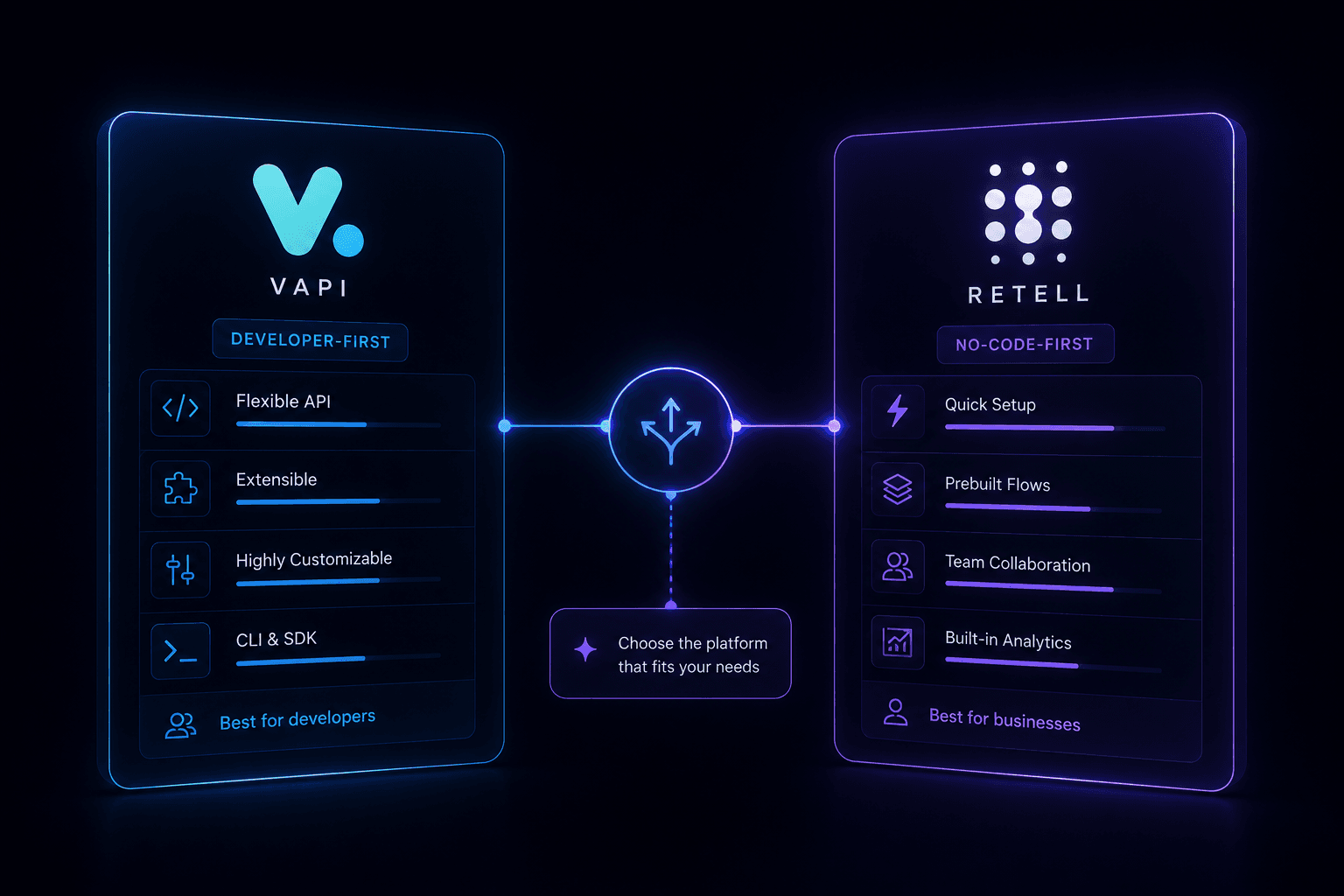
Use Vapi if you need maximum LLM flexibility, custom model endpoints, or granular API control. Use Retell AI if you want faster time-to-production, a cleaner dashboard, or built-in HIPAA compliance on any paid plan. Pricing is similar on both platforms. The real decision comes down to how much control you need versus how fast you want to ship.
What Vapi and Retell AI actually do
Both platforms sit between a phone call and an LLM. When someone calls a number, the platform:
- Receives the audio stream
- Runs speech-to-text (STT) to transcribe what the caller says
- Sends the transcript to an LLM with your system prompt
- Runs text-to-speech (TTS) to convert the LLM response to audio
- Plays that audio back to the caller
They also handle interrupt detection (when the caller talks over the AI), end-of-turn detection (when to stop listening and respond), call recording, transcripts, webhooks, and phone number management.
The difference is in how they handle each of these steps, and how much control they give you over the pipeline.
Pricing comparison
Both platforms use per-minute pricing, but the billing structure differs.
Vapi pricing (2026):
- Platform fee: $0.05/minute
- BYOK model: you pay STT, LLM, and TTS providers directly with your own API keys
- Total all-in with typical providers (Deepgram + GPT-4o-mini + Cartesia): $0.23–$0.35/minute
- No minimum commitment on the base plan
Retell AI pricing (2026):
- Bundled pricing: $0.21–$0.30/minute (STT, LLM, TTS, and platform included)
- BYOK option available at lower base rates for teams managing provider costs
- Volume discounts available from 50,000 minutes/month
Which is cheaper? At under 10,000 minutes/month, Retell's bundled pricing is simpler and often slightly cheaper all-in. At higher volume with BYOK, Vapi's lower platform fee can win if you negotiate rates directly with your providers. Neither is dramatically cheaper. Cost is rarely the deciding factor.
Latency comparison
Latency is the time between a caller finishing speaking and the AI starting to respond. Humans feel uncomfortable at over 1.5 seconds. Under 800ms feels natural. Both platforms can get there.
Vapi: Configurable based on your STT, LLM, and TTS choices. With Deepgram STT, GPT-4o-mini or Claude Haiku 4.5, and Cartesia TTS, you'll typically see 600–900ms end-to-end. With smaller locally hosted models, you can push below 500ms. You control the tradeoff.
Retell: Optimized for low latency out of the box. Their bundled pipeline typically achieves 500–800ms. Retell has invested in proprietary turn detection algorithms that make conversations feel more natural even before you tune anything.
Verdict: Retell has a slight edge on out-of-the-box latency. Vapi gives you more levers to pull but requires more tuning to match the same result.
LLM support
Vapi: Supports any LLM via a custom endpoint. Use OpenAI, Anthropic, Google, Groq, Together AI, or any model you self-host. This is Vapi's biggest differentiator: complete flexibility on the intelligence layer. If you have a fine-tuned model, you can plug it directly in.
Retell: Supports OpenAI GPT models, Anthropic Claude models, and a growing list of third-party providers. Less flexible than Vapi for custom models, but covers 95% of use cases. They add model support regularly.
Verdict: Vapi wins on LLM flexibility. If you need a fine-tuned model, want to switch providers for cost reasons, or plan to run your own inference, Vapi's open architecture is the right choice.
Voice quality and customization
Vapi: Integrates with ElevenLabs, Cartesia, Deepgram TTS, OpenAI TTS, and others. You choose and configure the TTS provider directly. Voice cloning via ElevenLabs is straightforward. Cartesia is the recommended default for low latency.
Retell: Has a strong ElevenLabs partnership and offers curated voice selections in the dashboard. Custom voice cloning is available. The out-of-the-box voices are production-quality without any additional configuration.
Verdict: Comparable. Both platforms support the same underlying TTS providers. Vapi gives slightly more configurability. Retell's curated selection gets you to production faster without making this decision.
Developer experience
Vapi: REST API with server-side SDKs for Node.js and Python, plus client-side SDKs for web, iOS, Android, and React Native. The API is verbose and highly configurable. Powerful, but steep learning curve. Docs are comprehensive but dense. Expect a few days to get your first agent running confidently.
Retell: REST API, Python and Node.js SDKs, and a visual flow editor in the dashboard. The API is more opinionated with fewer configuration options but cleaner defaults. A basic agent can go live in a few hours. The dashboard is more polished and includes built-in call analytics without additional tooling.
Verdict: Retell is faster to get started. Vapi rewards engineers who need granular control and are comfortable with dense documentation.
Enterprise and compliance features
Vapi:
- SOC 2 Type II in progress (as of 2026)
- HIPAA BAA available on Enterprise plan only
- Custom SIP trunking for enterprise telephony integrations
- White-label reseller capabilities
- On-premises deployment on Enterprise plan
Retell AI:
- SOC 2 Type II certified (completed 2025)
- HIPAA BAA available on all paid plans, not just Enterprise
- Built-in PII masking in call transcripts
- Configurable call recording and data retention policies
- Per-agent concurrency limits configurable in the dashboard
Verdict: Retell has a clear compliance edge for regulated industries. The HIPAA BAA on all paid plans (not just Enterprise) is meaningful for healthcare, dental, and insurance workflows where you need compliance from day one, not after you've signed an enterprise contract.
Telephony and call routing
Both platforms support inbound calls, outbound calls, phone number provisioning, and SIP trunking. The implementation details differ.
Vapi: Uses Twilio as the default telephony provider. You can bring your own Twilio account to control costs directly. SIP trunking lets you integrate with enterprise PBX systems. Number management is entirely through the API.
Retell: Supports Twilio and Vonage, plus SIP trunking. The dashboard has a built-in number management interface with area code selection. Concurrency limits are configurable per agent in the UI, which is useful for managing load on single-purpose agents without code changes.
Verdict: Similar capabilities. Retell's dashboard UI for number management is more polished. Vapi's BYOK Twilio integration gives more cost control at high volume.
Conversation design and multi-turn flows
Both platforms maintain conversation state across a full call. They take different approaches to how you define and manage that state.
Vapi: State is managed through your system prompt and function calls. Complex flows require engineering: you define logic in code, inject context via server webhooks, and handle branching programmatically. Maximum flexibility, but non-engineers can't modify conversation flows without a developer.
Retell: Offers a visual flow editor where non-engineers can define conversation branching, conditional logic, and call transfer conditions. For teams where ops or product manages conversation flows, this is a significant advantage over pure code-based configuration.
Verdict: Retell's flow editor is a real differentiator for teams that want non-engineers to manage conversation design. Vapi's code-first approach serves teams that need complex conditional logic and full programmatic control.
When to use Vapi
- You're using a fine-tuned or custom LLM that isn't available as a hosted API
- You need BYOK to control API costs at 100,000+ minutes/month
- Your team is engineering-first and wants API-level control over every component in the voice stack
- You're building a white-label voice AI product for resale to other businesses
- You want self-hosted deployment options in the future
- You're building complex multi-agent outbound systems with custom orchestration logic
When to use Retell AI
- You're in a HIPAA-regulated industry and need compliance from day one without an Enterprise contract
- You want to ship your first voice AI agent in days, not weeks
- Non-engineers on your team need to manage or iterate on conversation flows without writing code
- You're building for healthcare, dental, insurance, or other regulated industries
- You want built-in call analytics without setting up custom monitoring infrastructure
- You prefer a polished dashboard and visual tooling over maximum programmatic control
The 3-question decision framework
Answer these in order. The first yes stops the decision.
1. Do you need a fine-tuned or non-standard LLM? Yes: use Vapi. Its open model architecture is built for this.
2. Are you in a HIPAA-regulated industry? Yes: use Retell. HIPAA BAA on all paid plans, PII masking, and SOC 2 Type II certification give you compliance faster than Vapi's Enterprise-only path.
3. Does your team have a dedicated AI engineer? Yes: Vapi gives you the full power. No: Retell's visual flow editor and cleaner DX will ship you faster.
If none of these questions produce a clear answer, start with Retell. You can migrate to Vapi later if you need capabilities it can't provide.
Our recommendation
For most businesses building their first voice AI agent: start with Retell. You'll ship faster, the compliance story is better out of the box, and non-engineers on your team can iterate on conversation flows without waiting on engineering.
For teams building complex multi-agent outbound systems, running custom inference, or needing maximum programmatic control: Vapi. The API surface is larger, the model flexibility is unmatched, and BYOK gives you real cost control at scale.
Both platforms are production-grade and used at scale. We build on both at Hestur depending on client requirements. Neither choice is a mistake.
Frequently asked questions
Can I switch from Retell to Vapi after launch?
Yes, but it takes work. Your system prompts, webhook handlers, and telephony configurations are different between the two platforms. Expect 1–2 weeks of migration effort for a production agent. If you're unsure, start with Retell and move to Vapi if you hit a capability wall.
Does Retell's HIPAA BAA cover all data processed through the platform?
Retell's BAA covers call recordings, transcripts, and data processed through their platform. You still need to ensure your LLM provider (OpenAI, Anthropic) has their own BAA in place, since Retell passes data to them during calls. PII masking reduces PHI exposure in stored transcripts.
What does it actually cost to run 10,000 minutes per month on each platform?
At 10,000 minutes/month: Retell bundled pricing runs $2,100–$3,000. Vapi with BYOK (Deepgram + GPT-4o-mini + Cartesia) runs $2,300–$3,500 depending on negotiated provider rates. The difference is under $500/month at this volume. At 100,000 minutes/month, the gap widens and BYOK optimization on Vapi becomes meaningful.
Can I use LiveKit instead of Vapi or Retell?
LiveKit is an option but it's lower-level infrastructure, not a managed platform. With LiveKit, you build more of the voice pipeline yourself: STT integration, LLM orchestration, TTS streaming. It suits teams building at scale (10,000+ concurrent calls) who want maximum infrastructure control. For most teams, Vapi or Retell is the right starting point.
Do both platforms support outbound calling campaigns?
Yes. Both support outbound calls triggered via API. You pass a list of phone numbers and a call config, and the platform dials them. Vapi has more granular control over call pacing, retry logic, and concurrency through its API. Retell handles this well for most use cases but with less configurability. For large outbound campaigns at 1,000+ calls/day, evaluate both on concurrency limits before committing.
Which platform do you use at Hestur?
Both. We default to Retell for healthcare and dental clients where HIPAA compliance is required from day one. We use Vapi for clients who need custom LLM endpoints, white-label capabilities, or are building high-volume outbound agent systems at scale. The right platform depends on the use case, not platform loyalty.
Ready to build a voice AI agent?
We've built voice AI agents on both Vapi and Retell for businesses in real estate, healthcare, home services, and financial services. Whether you need an inbound receptionist, outbound follow-up agent, or a complex multi-turn booking flow, we scope and deploy in 2–4 weeks.
See what's possible: hestur.co/services/voice-ai