
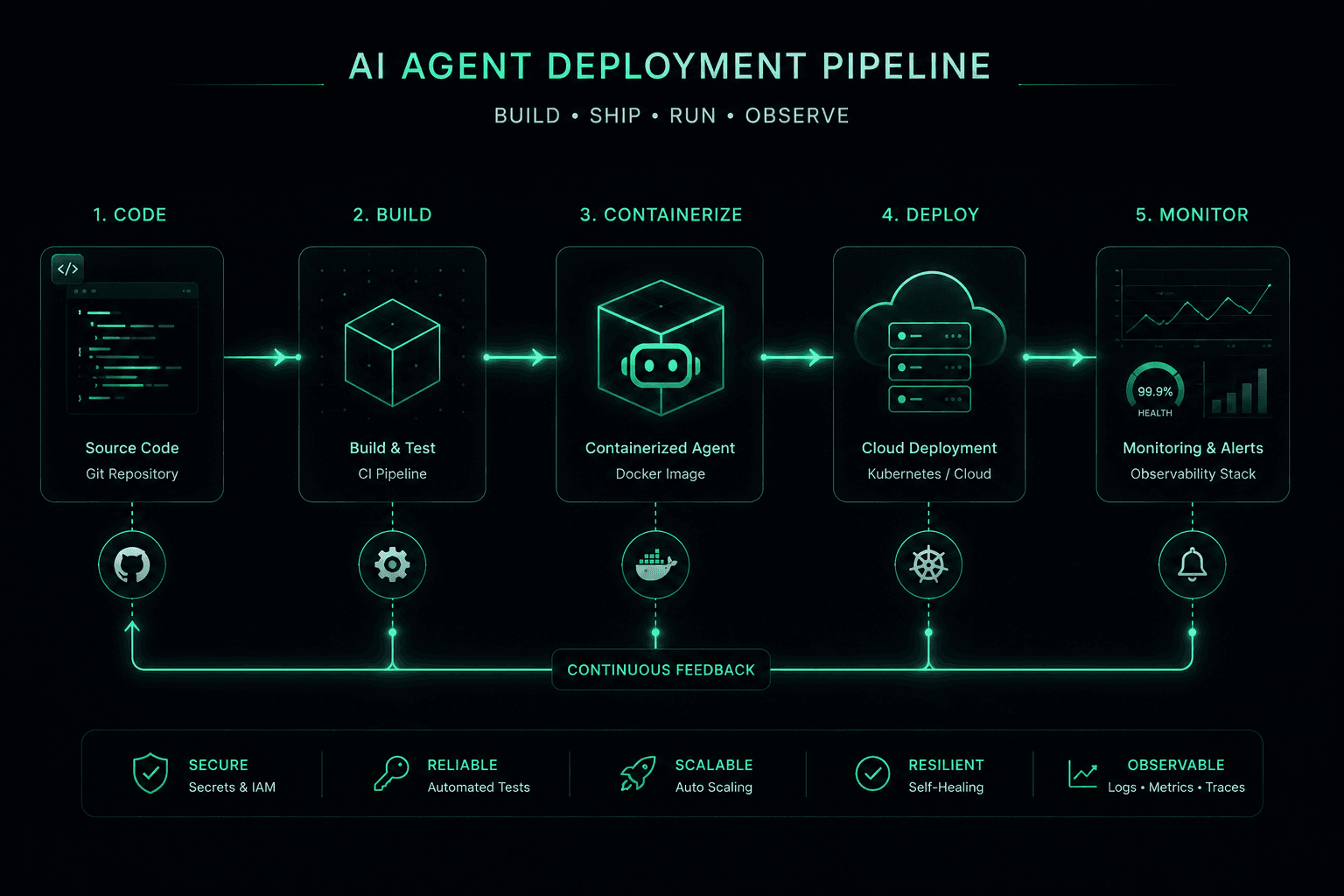
Deploying an AI agent is fundamentally different from deploying a traditional web service. The main differences lie in failure modes, observability needs, safety requirements, and the necessity of human fallback. This guide outlines four pillars for reliable production deployment:
1. Infrastructure: Build for Failure
LLM APIs are unreliable by default: rate limits, timeouts, and provider outages are normal. Your system must assume these will happen.
Key practices:
- Wrap every LLM call with:
- Retries using exponential backoff
- Specific handling for:
- Rate limits → back off and retry
- Timeouts → retry once immediately, then back off
- 5xx errors → retry up to 3 times, then fail gracefully
- On repeated failure, surface a clear, structured error to the human handoff layer instead of hanging or silently failing.
- Use queue-based architectures for high-volume workloads:
- Ingest requests into a queue
- Process via workers
- Gain natural retry, spike protection, and independent scaling of intake vs. processing.
- For voice agents, harden the audio pipeline as well as the reasoning layer:
- Handle dropped connections and network jitter
- Detect and manage cross-talk