
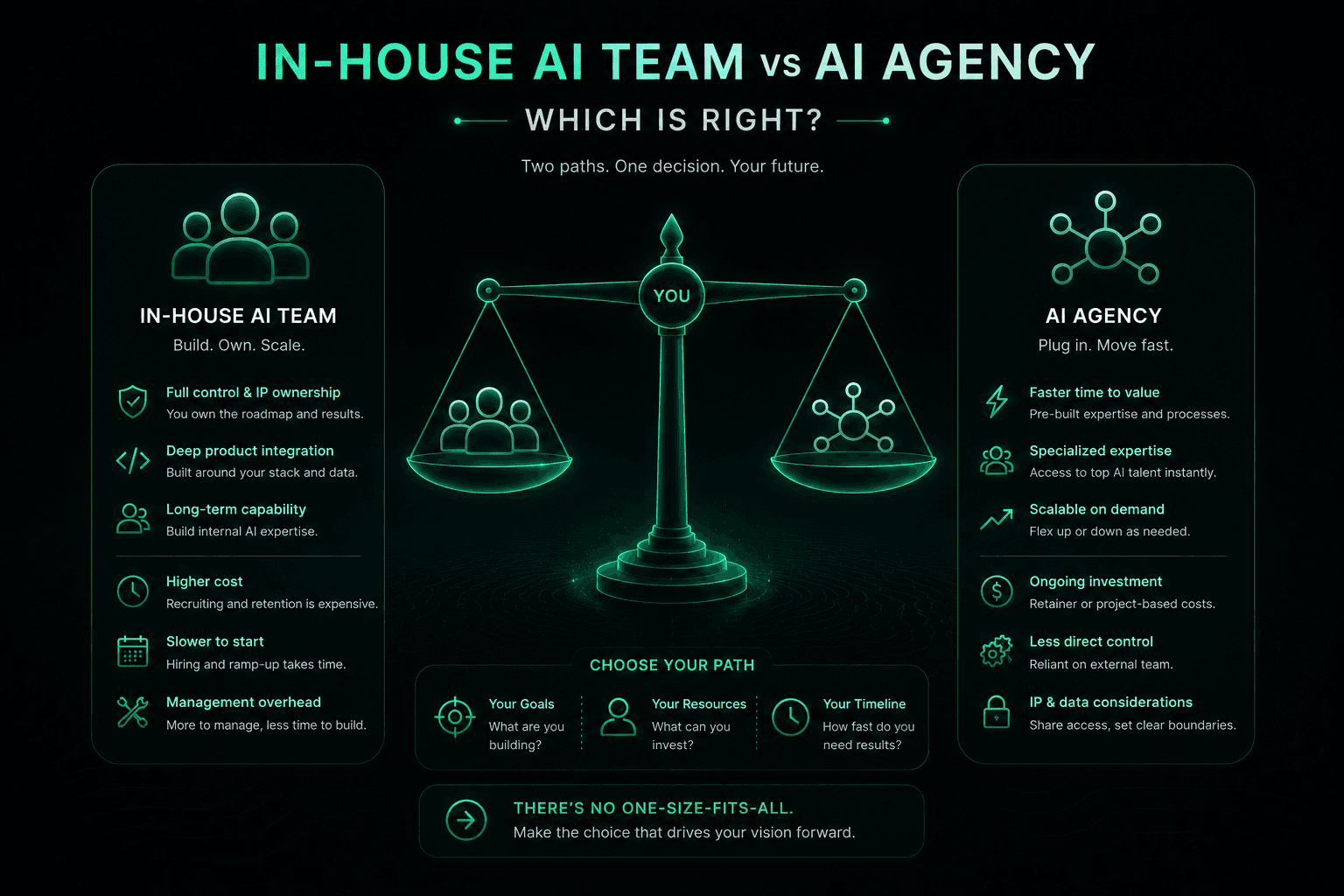
Most businesses reaching for AI face the same early decision: hire internally and build a team, or engage an agency to build it for you. Both paths can work. Both can fail. The right answer depends on factors that are often obscured by the excitement of the technology. Here’s a clear-eyed analysis.
The real cost of an in-house AI team
Building an in-house AI team is more expensive and takes longer than most organisations budget for.
A minimal viable AI engineering team capable of building and maintaining production AI systems requires at minimum:
- 1 senior AI/ML engineer: $180K–$280K/year (total comp in competitive markets)
- 1 backend engineer (integrations, APIs, infrastructure): $150K–$230K/year
- 1 product manager or AI product lead: $140K–$200K/year
Total annual cost: $470K–$710K/year before benefits, office space, tooling, infrastructure, and management overhead. Add 25–35% for benefits and employer taxes: $590K–$960K/year all-in.
This team can’t realistically start delivering until 3–6 months after the first hire (recruiting takes 2–3 months for each senior role, then onboarding, then ramping up). Your first significant AI deployment from a newly assembled team is typically 6–9 months after you begin hiring.
Ongoing costs include:
- Keeping up with rapidly evolving AI capabilities (continuous learning, conference attendance, tooling)
- Retaining talent in a competitive market (AI engineers have high mobility)
- Infrastructure and tooling costs ($5K–50K/month depending on scale)
- Manager overhead and coordination
The real cost of an AI agency
A well-scoped AI agency engagement for a production-ready system typically ranges from:
- Small project (PoC, single-workflow automation): $15K–50K, 4–8 weeks
- Medium project (multi-integration agent, RAG system, voice AI deployment): $50K–$150K, 8–16 weeks
- Large project (enterprise AI platform, complex multi-agent system): $150K–$500K+, 4–12 months
After the build, ongoing retainer for maintenance, improvements, and support: $5K–25K/month depending on scope.
Total first-year cost for a medium project: $100K–$250K all-in (build + retainer).
Where in-house wins
Long-term, high-volume AI work. If you have a clear, sustained AI roadmap — multiple systems to build over multiple years, requiring ongoing iteration — the economics shift toward in-house. The annual cost of a good agency engagement for ongoing work (>$200K/year) starts to approach the cost of employing 1–2 engineers.
Proprietary data advantage. If your AI systems depend on deeply embedded access to proprietary internal data and systems, in-house engineers can develop institutional knowledge that compounds over time. An agency will always have some overhead in re-learning your systems at the start of each engagement.
Highly sensitive data. If your AI systems process data that genuinely cannot leave your infrastructure (classified, highly regulated, extremely sensitive), in-house is sometimes the only option.
Culture and speed of iteration. Internal teams can iterate daily. Agency engagements are better suited to defined scopes and longer delivery cycles. If your use case requires constant, rapid iteration based on user feedback, internal capacity has an advantage.
Where an agency wins
Speed to first deployment. An agency with established infrastructure, tested patterns, and platform expertise can deploy a production voice AI agent or RAG system in 6–12 weeks. Building the same internal capability from scratch takes 6–9 months minimum.
Concentrated expertise. A specialist AI agency has engineers who have built 20–50 AI systems. They’ve made the mistakes, learned the patterns, and built the tooling. A newly hired AI engineer, however talented, takes 12–18 months to develop equivalent practical experience in your specific AI category.
No recruiting risk. Hiring senior AI engineers is genuinely hard. Top engineers have multiple competing offers. The recruiting process takes months and fails a non-trivial percentage of the time. An agency removes this risk entirely.
Cost-effective for bounded projects. For a well-scoped, contained project — one voice AI system, one RAG deployment, one automation workflow — agency economics are nearly always better than hiring. You pay for the outcome, not the overhead.
Flexibility. Agency engagements can be paused, scoped down, or ended if priorities shift. Internal headcount is much harder to unwind.
The hybrid approach most companies end up with
The most common pattern for mid-market and enterprise companies:
- Engage an agency to build the first 1–3 AI systems, establish architecture patterns, and validate use cases
- Hire 1–2 internal AI engineers to own, maintain, and iterate on the systems the agency built
- Use the agency for new capability development (new systems, new integrations, advanced features) while internal team handles operations
This hybrid gives you speed-to-market (agency), institutional knowledge (internal), and ongoing innovation capacity (both). The internal team’s job becomes easier because they’re maintaining well-built systems, not building from scratch.
Decision framework
Choose in-house if:
- You have a multi-year AI roadmap with consistent scope
- AI is core to your product (you’re building an AI-native product, not adding AI to an existing one)
- You have time to recruit (6+ months before you need delivery)
- Data sensitivity genuinely prevents external access
- You can compete on compensation for top AI talent
Choose an agency if:
- You need to move in weeks, not months
- This is your first significant AI project and you need expertise guidance, not just execution
- The scope is bounded (1–3 systems, not an ongoing AI platform)
- You want risk transfer (agency takes delivery risk, you pay for outcomes)