
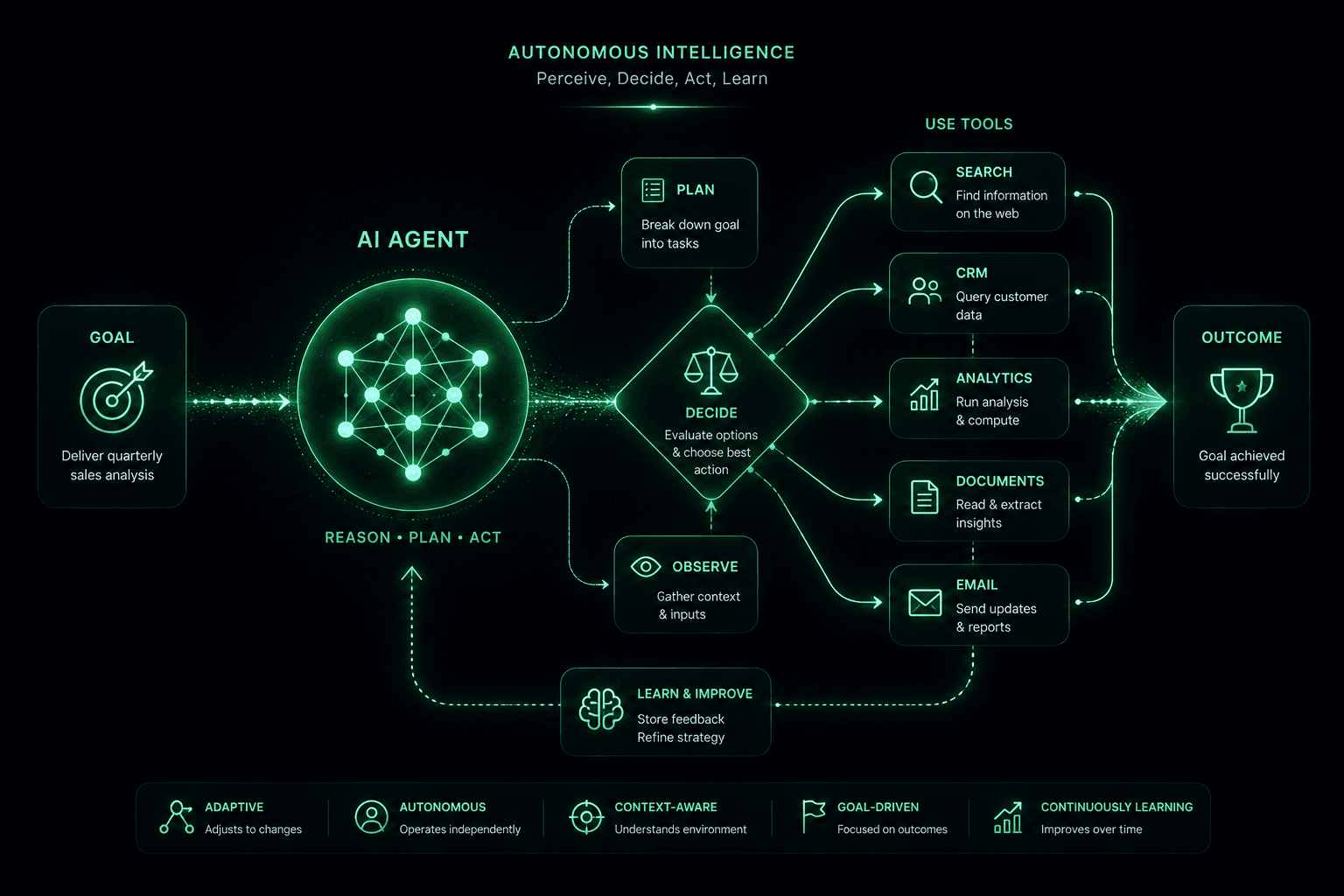
Agentic AI is AI that executes, not just answers. It breaks down goals, chooses actions, uses tools, observes results, and iterates until completion.
What makes AI “agentic”
- Loop (ReAct pattern) – Reason → Act → Observe → Repeat until done or a stop condition.
- Tools – Functions/APIs for search, databases, files, web, code, other agents.
- Memory – Persistent state across steps (context window, scratchpad, external store).
Without loop, tools, and memory, you have a chat completion, not an agent.
Why this is different from traditional automation
- Scripts/RPA/workflows: explicit rules, brittle, break when reality changes.
- Agentic AI: goal + tools; the LLM handles ambiguity and adapts via reasoning.
- Still imperfect (hallucinations, loops, wrong paths) but more robust on messy, real-world tasks.
Architectures
- Single-agent: One agent with tools and a system prompt handles the whole task. Best for focused, well-scoped jobs (e.g. booking meetings, document processing, research).
- Multi-agent: Orchestrator delegates to specialised agents (research, writing, QA, etc.). Handles more complex work but is harder to build, test, debug; failures compound.
Recommendation: start with a single agent; only move to multi-agent when context window or tool scope is the real bottleneck.
Real-world use cases
- Customer service: End-to-end refund handling (retrieve order, check policy, process payment, update CRM, notify customer, escalate edge cases).
- Sales development: Lead research, personalised outreach, sending and tracking messages, automated follow-ups at scale.
- Operations: Ingest invoices/contracts/applications, extract and validate data, route to systems, flag exceptions.
- Internal knowledge: Answer employee questions by searching internal docs and systems, then synthesising answers.
Tool categories that power agents
- Search & retrieval: Web search, vector DBs, document retrieval.
- Read/write data: Files, databases, spreadsheets.
- APIs: CRM, ticketing, calendar, payments, communication tools.
- Browser automation: Navigate UIs, fill forms, scrape when no API exists.
- Code execution: Run Python/JS for calculations and data transformations.
The power of an agent is bounded by its tools. Read-only tools → observation and reporting. Write-capable tools → true closed-loop execution.
Hard problems: reliability, safety, observability
- Reliability: Loops, bad tool arguments, misinterpreted instructions, compounding failures in multi-step flows.
- Safety: Write access can cause real damage (wrong deletions, emails, transactions). Need budgets, approvals, human-in-the-loop for irreversible actions, and dry-runs.
- Observability: Must log every step and state transition to understand and fix failures; standard app logs are insufficient.
Many projects fail moving from demo to production because they treat this as a prompting problem instead of a software engineering problem.
What agentic AI is not (yet) good at
- Long, precise workflows: a 10-step flow at 95% per step ≈ 60% end-to-end success.
- Complex, long-horizon, multi-party workflows.
- Physical-world tasks.
- High-stakes decisions needing expert-level judgement (legal, compliance, medical). Here, AI should assist humans, not replace them.
How to build your first agent
- Start narrow and well-scoped with a clear success metric.
- Build observability from day one.
- Keep a human in the loop for irreversible or high-impact actions.
- Run a short PoC (e.g. 2 weeks) on real data and tools to validate feasibility and surface blockers early.
To explore a tailored agentic system for your use case — tools, failure modes, and build timeline — you can book a free scoping call.