
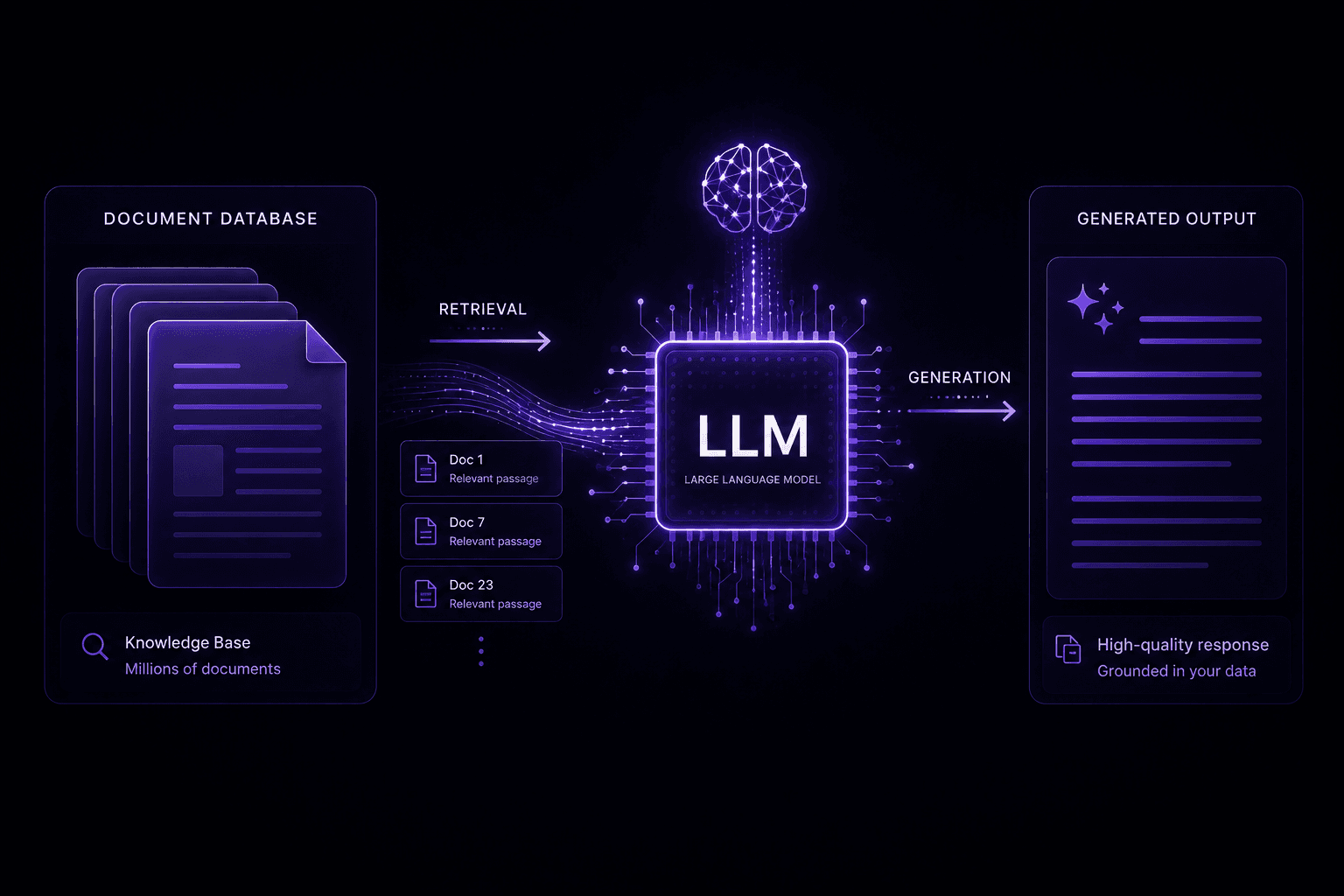
Retrieval-augmented generation (RAG) is the standard architecture for enterprise AI systems that must answer questions using proprietary or frequently changing data. Instead of relying only on what a language model learned during pretraining, RAG retrieves relevant information from a private knowledge base at query time and injects it into the model’s context, enabling accurate, citeable, and up-to-date answers.
Why RAG is needed
Base models like GPT-4o or Claude are trained on broad public data, so they generally don’t know:
- Your product docs, pricing, and roadmaps
- Internal policies, procedures, and playbooks
- Customer contracts, tickets, and account history
- Internal support knowledge bases
- Any information created or changed after the model’s training cutoff
Fine-tuning the model on this data seems appealing but is usually inferior for Q&A:
- Staleness: Every change in your knowledge requires new fine-tuning.
- Hallucinations: Fine-tuned models still guess when they lack specific facts.
- No citations: You can’t easily trace answers back to sources.
RAG cleanly separates reasoning (the model) from knowledge (your data) and treats retrieval as a first-class step.
Core RAG pipeline
- Ingestion
- Chunking
- Too small → loss of context
- Too large → irrelevant content mixed in
- Good chunking respects structure: sections, headings, paragraphs, semantic boundaries.
- Embedding
- Storage
- Retrieval & generation
- Embed the user’s question.
- Retrieve top‑K most similar chunks.
- Inject those chunks plus the question into the model’s prompt.
- The model generates an answer grounded in the retrieved content, with citations.
Why retrieval beats fine-tuning for Q&A
- Freshness: Updating knowledge is as simple as adding or modifying documents; no retraining required.
- Reliability: The model reasons over explicit retrieved facts instead of relying on memorised patterns.
- Citations: RAG can return the exact source chunks used, enabling verification and compliance.
The model becomes a reasoning engine with an external memory (your knowledge base), rather than a monolithic store of all facts.
What drives RAG accuracy
Most RAG failures come from retrieval issues, not the LLM itself:
- Poor chunking
- Splitting mid-sentence or mixing multiple topics in one chunk harms retrieval.
- Overlong chunks dilute relevance.
- Structure-aware chunking (by headings, sections, paragraphs) works best.
- Weak embeddings
- Generic embeddings may underperform on specialised domains (legal, medical, technical).
- Domain-specific or fine-tuned embedding models improve semantic matching.
- Bad retrieval results
- If the top‑K chunks don’t contain the needed information, the answer will be wrong.
- Hybrid search (vector similarity + keyword/BM25) usually outperforms pure vector search for enterprise content.
- Reranking: Retrieve a broader set (e.g., top‑20), then use a cross-encoder reranker to select the best few (e.g., top‑5) before sending to the LLM. This improves accuracy at the cost of some latency.
Advanced RAG patterns
Agentic RAG
The model actively decides when and how to retrieve:
- Issues multiple retrieval calls
- Queries different sources
- Refines search based on intermediate results
- Iteratively synthesises across chunks
This is more powerful but adds complexity and cost.
Why businesses need RAG — beyond the technology
The technical explanation of RAG is clear. The business case is often undersold. Here is where RAG creates direct commercial value.
Customer support: deflect tickets with accurate answers
The most immediate ROI for most businesses is customer support deflection. A RAG system trained on your product documentation, help articles, and policy docs can answer 60–70% of inbound support tickets accurately and with citations. Industry benchmarks (Zendesk, Gartner) suggest the cost per AI-deflected ticket is $0.10–$0.50 vs. $5–$15 for a human-handled ticket. At 10,000 tickets per month, that is a six-figure annual saving.
Enterprise knowledge base: employees get answers instead of digging
Knowledge workers spend an estimated 20% of their time searching for information (McKinsey Global Institute). A RAG system over your internal knowledge base — policies, procedures, contracts, historical decisions — cuts that search time significantly. The AI answers the question and cites the exact document and section, so the employee can verify rather than hunt.
Sales and revenue enablement
Sales reps lose deals when they can't quickly retrieve accurate product specs, case studies, or competitive positioning during a call. A RAG system over your sales enablement content gives every rep instant access to the right answer with a source they can forward to the prospect. Onboarding time for new reps drops when they have an always-accurate knowledge assistant instead of a folder of PDFs.
Compliance and auditability in regulated industries
In financial services, healthcare, and legal, every AI-generated answer needs to be traceable to a source. RAG provides that by design: the system returns both the answer and the chunks it was retrieved from. An auditor can verify that an AI-generated compliance summary was grounded in the correct version of the policy document, not a model's memorised approximation of it.
What RAG costs — and when it pays for itself
An entry-level RAG system — single knowledge base, one use case, standard retrieval — runs $15K–$30K to build and $1K–$3K per month to operate. At 60% deflection on 5,000 monthly support tickets at a $10 human-handled cost, the system pays for itself in under 90 days. Enterprise RAG systems start at $100K+ and the ROI case shifts from ticket deflection to knowledge worker productivity and compliance risk reduction. See the RAG pricing page for a full breakdown.