
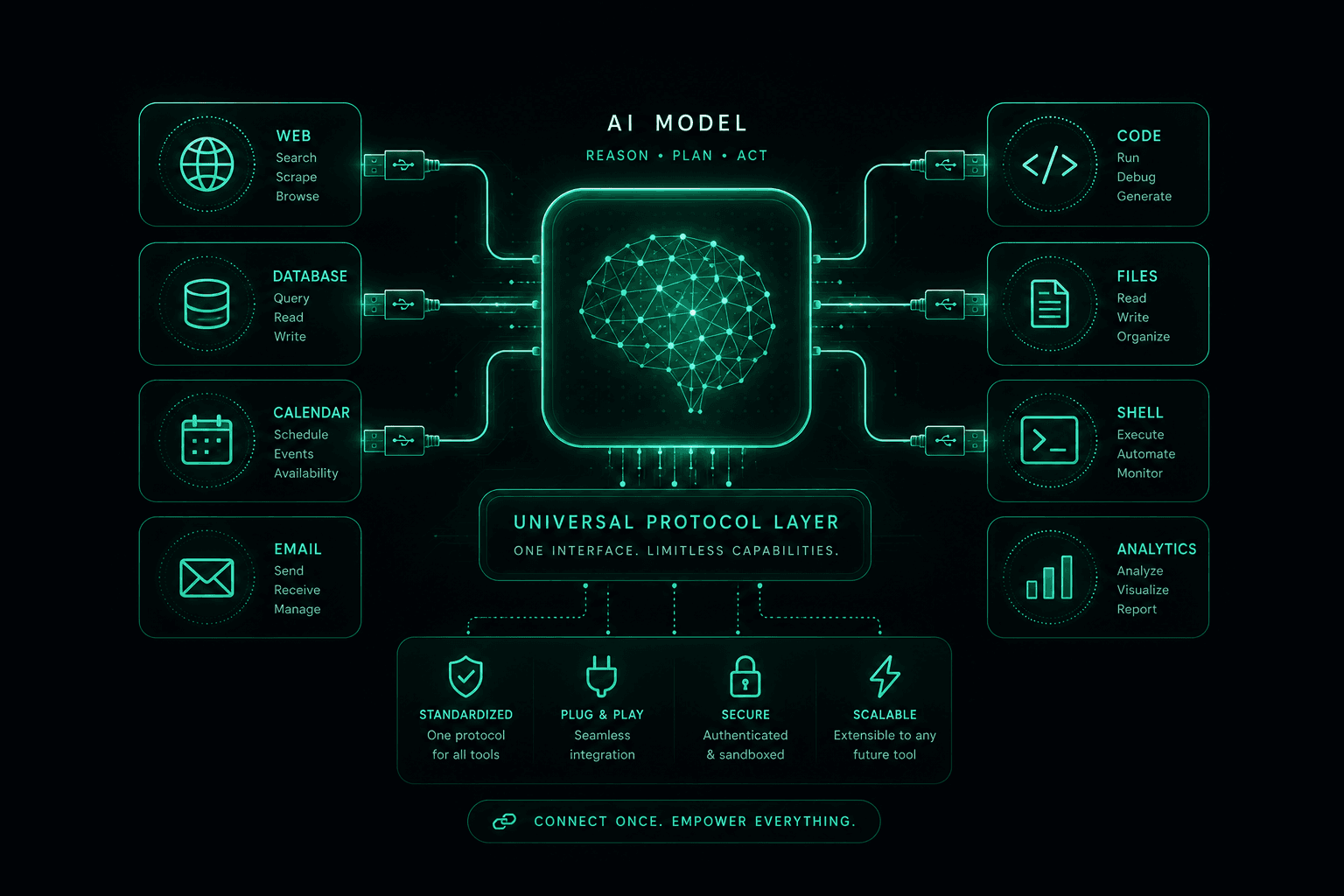
Model Context Protocol (MCP) is a JSON-RPC 2.0–based standard that lets AI agents talk to tools, data sources, and services in a uniform way, replacing bespoke per-model/per-tool integrations with a single shared wiring layer.
Core idea
- Before MCP: M×N problem — each of M models needed custom connectors to each of N tools.
- With MCP: M+N — each model implements MCP once; each tool exposes a single MCP server; any compliant model can use any compliant tool.
MCP (Model Context Protocol) is an open standard that lets AI applications connect to external tools, data sources, and services through a single, consistent interface—like a USB-C standard for AI integrations.
Instead of writing custom, one-off integrations between each AI app and each system (Google Drive, CRMs, databases, calendars, etc.), MCP defines a common protocol so that:
- Hosts (AI applications like Claude Desktop, IDE agents, custom agents) can discover and use capabilities exposed by
- MCP Servers (small programs that wrap systems like file systems, GitHub, Google Drive, Slack, databases, etc.) via
- A standard protocol that exposes:
- Resources (readable data: files, records, events, emails)
- Tools (actions: search, write files, send emails, query DBs, call APIs)
- Prompts (reusable prompt templates)
Communication happens over JSON-RPC, with each MCP server holding its own credentials and exposing a manifest that describes its capabilities. The AI host just calls tools and reads resources through this standard interface.
This solves the fragmentation problem where every AI app needed bespoke integrations for each system, making assistants isolated from the rest of the digital environment. With MCP, integrations become reusable and composable: once you have an MCP server for a system, any MCP-capable AI host can use it.
Example: law firm assistant
For a law firm that needs to:
- Search case files in S3
- Look up client matters in a practice management system
- Check billing software for invoices
- Create calendar events
- Read/draft Outlook emails
Without MCP: 4–5 separate, custom integrations with their own auth, error handling, and data mapping. Swapping AI models often means rework.
With MCP: 4–5 MCP servers (one per system). Any MCP-capable AI host can connect to them via the same protocol. Changing models or host frameworks doesn’t require rebuilding the integrations.
Ecosystem status (mid-2026)
- Claude Desktop, VS Code AI features, Cursor, and Windsurf support MCP.
- Many official/community servers exist (filesystem, GitHub, Google Drive, Slack, Notion, Postgres, SQLite, browser control via Puppeteer, Brave Search, etc.).
- LangChain and LlamaIndex have MCP adapters.
- Reference implementations in Python and TypeScript make it relatively quick to build servers.
What you can build today
- Internal search across systems (Confluence, Notion, Google Drive, codebase) via multiple MCP servers.
- CRM workflows that combine Salesforce, Zendesk, DocuSign data.
- Developer automation (codebase access, GitHub issues/PRs, tests, shell commands) through coordinated tools.
- Voice agents with system access that can read/update CRM and order data in real time.
Security considerations
Because MCP servers hold real credentials and can perform real actions:
- Apply least privilege to each server.
- Ensure server authentication so only authorised hosts connect.
- Carefully scope tools for autonomous agents to limit blast radius.
- Implement audit logging for sensitive data and actions.
When to use MCP
- If your AI application needs to access or update real systems (typical in enterprise scenarios), MCP is mature and worthwhile now. Each MCP server you build becomes reusable across all your AI apps.
- If you only need a static-knowledge chatbot, MCP may be unnecessary overhead—for now. As soon as you need live access to systems (“the AI should access or update X”), MCP is the right architectural choice.